
A camera crew standing in the wrong place can stop a production line, enter an exclusion zone or distract someone carrying out a high-risk task. That is why an industrial filming safety guide must begin with the site, not the shot list. The strongest industrial video is built around safe access, operational awareness and a clear business purpose – whether the asset supports recruitment, training, stakeholder communication or brand credibility.
Industrial filming is not simply corporate filming with more PPE. Mines, manufacturing plants, warehouses, construction environments, processing facilities and utilities sites each operate under their own controls, permits and rhythms. A production approach that respects those conditions protects people, keeps the project moving and produces footage that genuinely reflects how the organisation works.
Start the industrial filming safety guide before creative development
The best time to solve safety issues is before a crew arrives with cases, lights and cameras. A production partner should first understand what the video needs to achieve, then design a practical way to capture it. If the purpose is a recruitment campaign, for example, the priority may be showing skilled people, team culture and well-managed operations. If it is a training video, the priority is accuracy, clear process visibility and controlled demonstrations.
That distinction matters. A dramatic shot that requires access to a restricted area may not be necessary if a safer angle tells the story just as effectively. Equally, a training sequence may need close-up detail that requires a planned shutdown, a dedicated demonstration area or approved site personnel rather than filming a live task.
Early scoping should establish the site location, operating environment, intended filming dates, crew size, access requirements and likely production methods. It should also identify whether filming will occur around mobile plant, at height, near moving machinery, in confined spaces, on active construction zones or in areas with sensitive information. These are not details to resolve on the morning of the shoot.
For Australian organisations, requirements will vary by state, territory, industry and site operator. The site’s work health and safety procedures remain the controlling framework. Production documentation should align with them, rather than treating a generic risk assessment as a substitute for site-specific planning.
Build the right approvals, documents and responsibilities
A site visit or detailed pre-production discussion is usually the most efficient way to identify the real constraints. It lets the production team map safe camera positions, assess noise and lighting conditions, understand vehicle routes, and plan around shift changes or maintenance windows.
Depending on the site and scope, the production may require induction completion, certificates of currency, risk assessments, a safe work method statement, permits, a job safety analysis or sign-off from the site safety representative. The exact documentation depends on the work being performed and the organisation’s procedures. What matters is that responsibilities are clear.
The client should nominate an authorised site contact who can confirm access arrangements, current operational conditions and any changes on the day. The production lead should manage the crew, equipment and agreed filming plan. Neither party should assume the other is monitoring a hazard.
This is particularly important where filming intersects with operational work. A camera operator is focused on framing. A spotter, escort or site representative may be needed to maintain awareness of plant movements, changing exclusion zones or nearby work activity. One person cannot always do both jobs safely.
Plan around operations, not against them
Industrial sites are productive workplaces first. A filming schedule should fit the operational reality rather than asking a busy team to reshape its day around a production crew.
That may mean filming particular processes during a quiet window, capturing wide site visuals from approved locations, or using a staged but accurate demonstration for close-up shots. Staging is not inherently a problem. Misrepresenting unsafe behaviour, bypassing controls or asking workers to repeat live tasks for the camera is.
Production planning should account for the practical factors that can interrupt a shoot: weather, equipment outages, shift handovers, contractor activity, deliveries, alarms, cleaning cycles and changing work fronts. Allowing time for these variables is commercially sensible. It reduces rushed decisions and prevents a missed shot from becoming pressure to take an unnecessary risk.
It is also worth protecting worker dignity. People should know why they are being filmed, what is expected of them and how the material may be used. For recruitment and culture content, natural interactions are often far more credible than directing people to perform enthusiasm between demanding tasks. For operational or safety footage, employees should never be encouraged to remove required PPE or alter a safe procedure to improve the image.
PPE is a control, not wardrobe
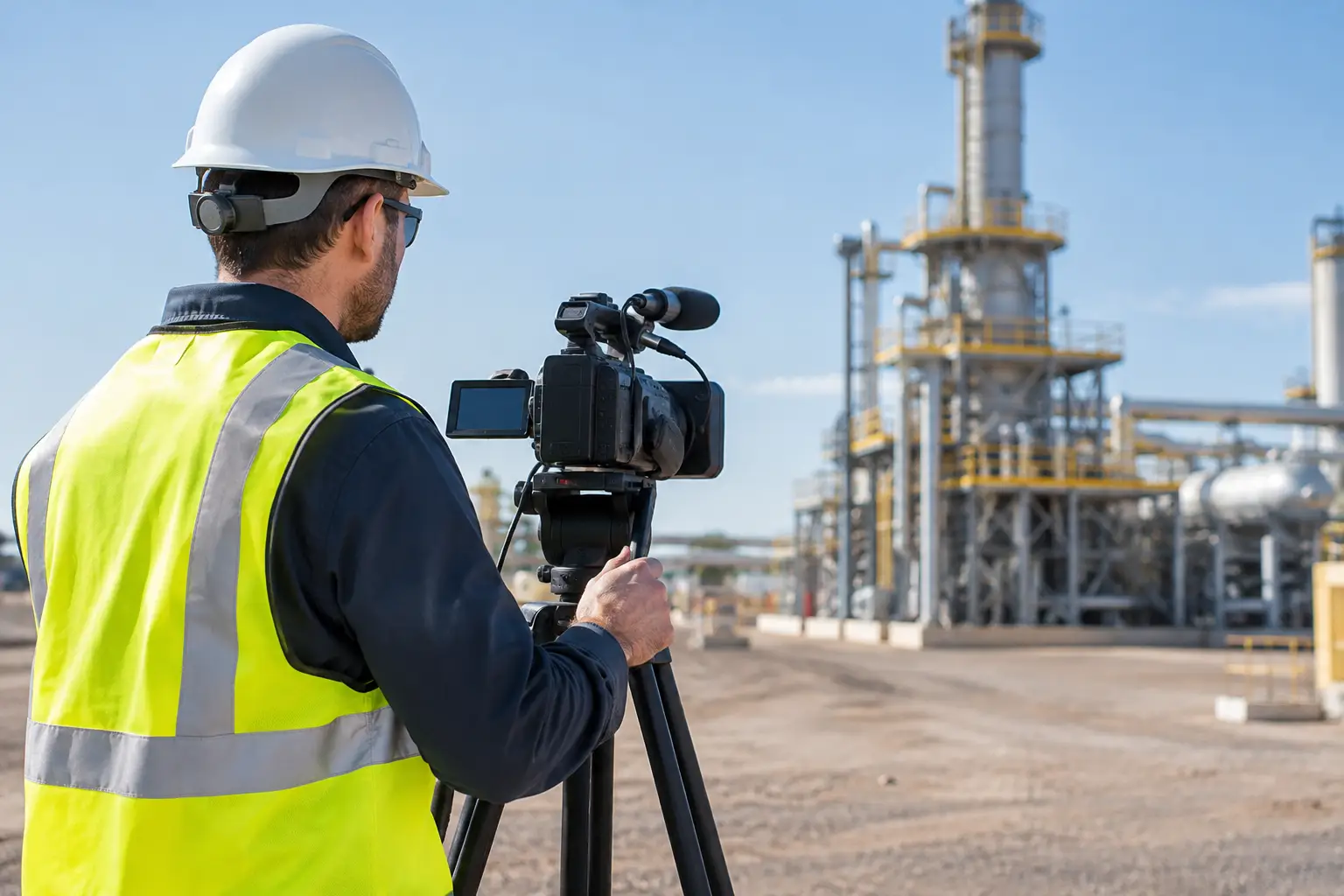
Hard hats, high-vis clothing, eye protection, hearing protection and safety footwear can help tell an authentic visual story, but they are not styling decisions. Everyone on site – including producers, camera operators, photographers and clients – must meet the PPE requirements for the area they enter.
The right PPE also depends on the task and environment. Wearing standard PPE does not authorise a crew to enter a restricted zone, work near energised equipment or approach moving machinery. The control measures set by the site still apply.
Manage camera, lighting and drone risks on the day
Production equipment introduces hazards of its own. Tripods, cable runs, light stands, monitors and cases can create obstructions in thoroughfares, near stairs or beside work areas. Good housekeeping is part of the filming plan: keep equipment compact, secure cables, maintain clear walkways and return unused cases to a designated safe area.
Lighting deserves particular attention. Extra light can improve an interview or reveal detail inside a facility, but it can also create glare, heat and distraction. It should never compromise a worker’s visibility, interfere with signage or be positioned where it affects drivers, plant operators or people working at height. In many operational environments, available light and carefully chosen locations are the safer option.
Before filming begins, the production lead should confirm the day’s controls with the relevant site contact. A useful pre-start covers the planned locations, exclusion zones, emergency arrangements, communication method, weather conditions and any changes since the risk assessment was prepared. If circumstances change, the plan changes too.
The following controls are often necessary when filming on active industrial sites:
- Maintain separation from moving plant, vehicles and operating machinery, using approved camera positions and exclusion zones.
- Keep a clear route for emergency access, pedestrians and operational traffic at all times.
- Stop filming when a task, alarm, weather event or changing site condition makes the agreed plan unsafe.
- Use a site escort, spotter or traffic management control where the risk assessment requires one.
- Secure all equipment and avoid leaving cameras, bags or cases where they can become trip hazards or projectiles.
Drone filming requires another layer of planning. Aerial footage can communicate scale, access and investment quickly, especially across industrial estates, property developments and large facilities. But it must be planned around airspace, people, operations, privacy, site permissions and applicable aviation rules. In some situations, a drone is not the right tool at all. Ground-based elevated perspectives, existing approved imagery or filming during a controlled window may deliver the outcome with less disruption.
Capture credible safety culture without manufacturing it
Clients often want footage that demonstrates a strong safety culture. The temptation is to focus on PPE, warning signs and formal inspections. Those visuals have a place, but they are only part of the story.
Credible safety content shows systems working in context: a pre-start conversation, a supervisor checking conditions, workers using the right access route, clear communication around plant, or a team member confidently explaining a procedure. It should reflect the organisation’s actual standards, not create a polished version of site behaviour that employees do not recognise.
This requires sensible creative judgement. Avoid filming licence plates, control screens, confidential documents, security infrastructure or proprietary processes unless they have been approved for release. Consider who else may be visible in the background, including contractors and visitors. For government, health, utilities and critical infrastructure environments, communications and security review may be as important as the physical filming plan.
The same principle applies in post-production. Editing should make the message clear without implying that a risky act is acceptable. If a sequence could be misunderstood without context, narration, on-screen text or a different angle may be needed. A video used repeatedly in induction or training has a long life, so accuracy is more valuable than a rushed creative shortcut.
Make safety part of the production outcome
A well-run industrial shoot does more than avoid incidents. It protects continuity, helps workers feel respected and gives stakeholders confidence that the organisation operates with discipline. It also produces better material because crews who understand the environment can focus on the moments that matter instead of chasing access at the last minute.
At THIRTY3SOUTH Films, that means treating safety planning as part of the strategic production process, alongside messaging, scheduling and delivery requirements. The aim is not to make a site look more dramatic than it is. It is to create useful visual content that shows capable people doing meaningful work, under conditions that are properly planned and controlled.
When the filming plan gives safety the same weight as the creative brief, the final video has a better chance of doing its job: representing the organisation honestly, reaching the right audience and leaving the operation exactly as it found it.