
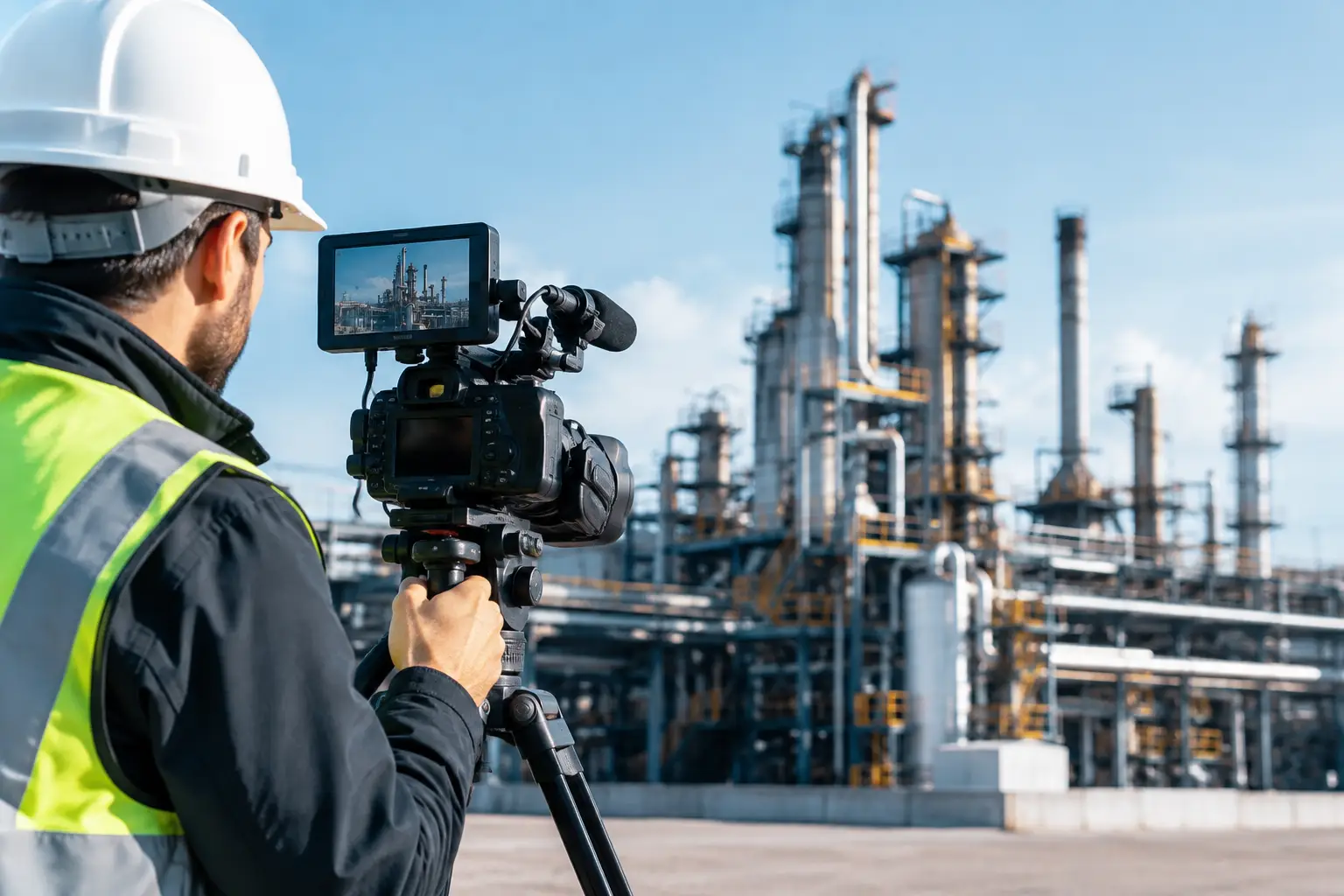
A refinery shutdown, a manufacturing line or a mine-site induction is not a place for a camera crew to arrive with a loose brief and hope for useful footage. Industrial videography needs to work within real operating conditions: permits, PPE, shift changes, restricted areas, safety requirements and people who have a job to do. The result still needs to look polished, but more importantly, it needs to communicate clearly and perform a defined business function.
For industrial organisations, video can make complex operations understandable without oversimplifying them. It can show the calibre of a workforce, the scale of an asset, the discipline behind a process or the practical value of an investment. Done well, it gives audiences a view of the business they would otherwise never have.
What industrial videography needs to achieve
Industrial video is often treated as a single category, but the right approach depends on the audience and the decision or behaviour the video needs to influence. A recruitment film needs to help prospective candidates picture themselves in the role. A safety video needs to be direct, accurate and easy to recall in the field. A capability film may need to build confidence with clients, stakeholders or procurement teams before a conversation even begins.
That means the starting point is not the camera package. It is the communication objective.
A clear brief should establish who needs to see the video, what they need to understand and what action should follow. For example, a manufacturer launching an automated production upgrade may need a hero film for customers, short social cut-downs for sales teams and a technical asset for distributors. The footage can be captured in one production window, but each edit should be built for its own purpose.
This is where industrial videography becomes more than documentation. It becomes a practical business asset that supports communication across marketing, operations, HR and stakeholder engagement.
The challenge of filming real operations
Industrial environments are visually compelling because they are real. Machinery moves, people solve problems, materials are transformed and systems operate at scale. But those same conditions create constraints that need careful planning.
Access is a common issue. Some areas may require inductions, escorts, security clearances or permits. Others may only be available during a narrow production window, such as a planned maintenance period or a specific stage of the manufacturing process. In active workplaces, filming cannot disrupt output or create an additional safety risk.
There is also the matter of accuracy. A generic shot of a worker turning a valve may look convincing, but it can be misleading if it does not represent the actual procedure. For technical audiences, detail matters. The right production partner asks enough questions to understand what is happening on screen, which people need to approve it and where simplification could create a problem.
Sound presents another challenge. Industrial sites are rarely quiet. Depending on the objective, natural sound may add energy and credibility, while interviews may require carefully selected locations, radio microphones and controlled timing. It depends on whether the audience needs to feel the environment or hear precise information from the people within it.
Start with site planning, not a shot list
A shot list is useful, but it should follow a proper site plan. Before filming, the production team should understand the site rules, hazards, access requirements, key personnel and operational schedule. This process protects the crew, respects the workforce and avoids lost production time.
A productive pre-production process usually includes a location review, safety documentation, site induction requirements, a filming schedule and an agreed approvals pathway. It should also identify what cannot be filmed, whether that is confidential technology, control screens, client information, sensitive infrastructure or personnel who have not provided consent.
For larger or higher-risk sites, the production schedule should allow room for the reality of operations. A delayed delivery, weather event or equipment issue can change the day quickly. Planning for alternatives is not overcautious. It is how the production remains efficient when site conditions change.
The same principle applies to drone footage. Aerial vision can establish the scale of a facility, transport route, construction project or regional operation in seconds. Yet drones are not appropriate for every environment. Airspace restrictions, proximity to people, moving plant, weather and site policy all need to be assessed well before the filming day. Where aerial footage is viable, it should serve the story rather than simply provide a dramatic opening shot.
Show the people behind the process
Industrial organisations often focus their messaging on assets, capability and output. Those are important, but audiences also look for evidence of the people, standards and thinking behind the operation.
A technician explaining why a quality check matters can carry more authority than a page of corporate copy. A supervisor describing the path from apprenticeship to leadership can make recruitment messaging feel credible. A project manager walking through a completed facility can give stakeholders confidence that the work was delivered with care.
These are not scripted performances in the traditional sense. They are guided conversations with people who understand the work. Good interviewing creates space for clear, natural answers while keeping the message focused on what the audience needs to hear.
That human element matters even in highly technical communication. People make decisions about suppliers, employers and investments. They respond to competence, pride, clarity and proof. Industrial video should show the process, but it should also reveal the people accountable for doing it well.
Build for multiple uses from the outset
A three-minute capability video may be the central asset, but it is rarely the only deliverable worth producing. Industrial organisations often need content across websites, tenders, presentations, internal channels, recruitment campaigns, trade events and social platforms.
Planning for these uses during pre-production makes a material difference. Vertical framing may be needed for mobile channels. Interview answers can be structured to create standalone short clips. Photography can be captured alongside video to support case studies, campaign materials and media activity. Motion graphics can make processes, data or site maps easier to understand where live-action footage alone cannot explain the full picture.
This approach also creates better value from site access. If a crew is already inducted, mobilised and working around operations, it makes sense to capture a considered library of footage that can support future activity. The goal is not to collect hours of vision for its own sake. It is to create a useful, organised bank of approved assets that reduces the need to start from scratch for every new communication requirement.
Keep safety and brand standards visible
Viewers notice details. Incorrect PPE, poor housekeeping, unsafe behaviour or inconsistent branding can undermine an otherwise strong production. In industrial sectors, these details are more than visual issues. They can affect credibility with employees, clients and regulators.
The production team needs to work with site representatives to make sure filming reflects genuine procedures. That may mean checking PPE requirements for each location, coordinating around plant movement, confirming safe positioning for cameras and ensuring the final edit does not unintentionally show a breach of policy.
There is a balance to strike. A video should not feel sterile or staged, but it should show the organisation at its best. That is achieved through preparation, direction and close collaboration with the people who know the site.
Measure the outcome the video was made for
The performance of industrial videography cannot be judged by views alone. A high view count may be useful for brand awareness, but it says little about whether a training video improved understanding or a recruitment campaign generated suitable applicants.
Success measures should reflect the job of the content. For a sales asset, that may be stronger engagement in proposals or longer viewing time on a service page. For internal communications, it may be completion rates, employee feedback or fewer recurring questions. For recruitment, it could be qualified applications, event engagement or candidate perceptions of the workplace.
Measurement does not need to be complicated, but it should be agreed early. It helps shape the content and gives the organisation a clearer basis for deciding what to produce next.
THIRTY3SOUTH approaches industrial video as a coordinated production process, from strategy and scripting through site filming, editing, animation and delivery formats. The objective is not simply to make a site look impressive. It is to create content that gives the right audience a reason to understand, trust or act.
The strongest industrial films respect the reality of the workplace while making its value easy to see. When the purpose is clear and the production is properly planned, even the most complex operation can become a story people can follow and a business tool people can use.